Stereotypes: A Mental Shortcut

As I was listening to some presentations two weeks ago, there was one that really stood out to me. The topic of this presentation was stereotypes and how it is exploited in the media. As a future engineer myself, I have also noticed that most of the students are the typical boys. Did you expect any different? We all picture a scientist as a man, most of the time even an older man with a grey beard. Our everyday life is full of stereotypes: women can’t park, men are the smarter sex, men are better at sports, women love to shop, etc.

Now, what is a stereotype? A stereotype is an oversimplification of a group of people. Not to be confused with generalizations, a stereotype is a generalization but not all generalizations are stereotypes. It’s not always easy to recognize a specific stereotype. Some do make sense, while other have no truth to them at all.

But why do we use stereotypes? Some psychologists have tried to answer this question, but they are not completely sure. Saul Mcleod explains that it gives us the benefit of being able to respond rapidly to situations, because we may have had similar experiences before. It’s kind of a mental shortcut that helps us feel that we know what is going on in our social world. “It saves us time of getting to know every single individual”, says another psychologist named Lancaster.

Although this all sounds very beneficial, we all know stereotypes aren’t always a good thing. Using stereotypes causes us to block out other observations. In addition, we only see what fits the stereotype, in other words: what we want to see. Besides, we all have been hurt before or seen someone get hurt by stereotypes. There are the classic nerd jokes or the assumptions that blondes are dumb, these stereotypes do make victims every day. But as stereotypes are a mental shortcut, they aren’t likely to go away anytime soon. However, this  should not mean that they should be used in advertising or in the media. On the contrary, if the media starts portraying these stereotypes differently, we may outsmart our brains.


Sources:

Presentation by Arne Persyn

https://cardinaltimes.org/11875/news/the-science-behind-stereotypes/

https://www.thoughtco.com/what-is-the-meaning-of-stereotype-2834956

https://examples.yourdictionary.com/stereotype-examples.html
 

Why You Should Not Heat a Cup of Water in the Microwave


Have you ever heated a cup of water in the microwave? Chances are you’ll never do it again after reading this.

Before I explain why you shouldn’t heat up a cup of water in the microwave, let’s first discuss how a microwave works. The microwave has a part that produces electromagnetic waves, more specifically microwaves. These microwaves, with a wavelength of 1 mm to 1 m, are send through your food to heat it up. Your food exist of molecules, like everything essentially does. The microwaves cause vibration of those molecules and therefore heat is produced. Nevertheless, not every molecule produces heat at the same rate. Molecules like fats or carbohydrates produce heat faster. The molecules that don’t heat that easily are then heated because of the heat transfer through the produced steam. This process is the reason why you’re food often isn’t heated evenly.

Now let’s see what happens if you warm a cup of water. The microwaves have so much energy that they’ll easily warm your cup of water to a temperature higher than 100 °C. Essentially, if it starts boiling, there’s no problem. The problem only arises when the water does not boil at 100 °C, but gets superheated. Superheated water is a stable form, so if not interrupted, nothing will happen. The danger is that only one small heterogenic element is necessary for the boiling process to start. The cup exists of millions of water particles, so if the boiling process starts, every particle immediately transfers from the liquid phase to the gas phase. This phase transition releases an enormous amount of energy, hence the  stability is increased by transferring to the gas phase, resulting in an explosion. Normally, the worst that can happen is that you have to buy a new microwave, but caution is necessary: you’ll never know when the boiling process will start.

Despite what you might think, heating up a cup of soup or any other beverage will not cause any harm. In these beverages, there are heterogenic particles and the water will not get superheated. So next time you’d like a cup of tea, think twice before heating it up in the microwave!


Sources:
http://sieplex.com/article/oververhit-water
https://en.wikipedia.org/wiki/Superheated_water

Why does rubbing alcohol feel cold?

You probably had to have shots before. You probably remember the cold feeling you had when they wiped your arm clean right before they put the needle in.

Have you ever wondered why your arm feels cold when they disinfect it? Well, it’s a very simple natural process called ‘evaporative cooling’. It’s the same process that explains why we sweat.

Imagine a hot summer day, it’s 30 °C outside, the sun is burning, sweat is forming on your forehead: the evaporative cooling has started. Now what is evaporative cooling exactly? Let us first explain evaporating. We all know water evaporates. The evaporating, going from a liquid to gas, happens because gases have a higher energy level. This means that molecules would rather be in the gas phase than in the liquid phase. When the liquid is water, evaporating means breaking the hydrogen bonds  that are present in the liquid form. The breaking of the bond (one of the strongest bonds) requires energy or heat. This means while we sweat, heat is taken from our body and our body cools down and overheating is prevented. This explains why it’s called ‘evaporative cooling’.

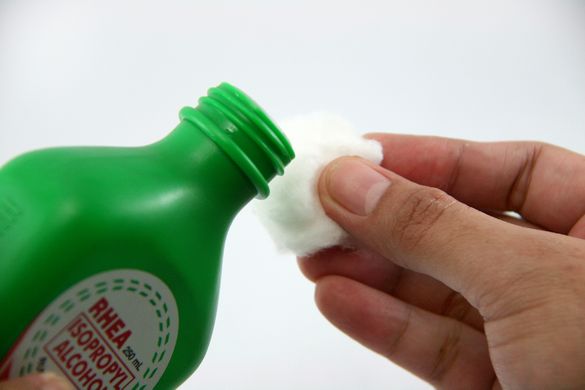
The same thing happens with rubbing alcohol. Rubbing alcohol is a mixture that contains mostly isopropyl alcohol, but also water, denaturants and perfume oils. It is derived from crude oil and processed until it can be used as a disinfectant. It removes germs (but not all of them) and is therefore also used in hand sanitizers.

As rubbing alcohol exist mostly of isopropyl alcohol, it contains the same characteristics. Therefore it has a much lower boiling point than water (about 82 °C). Thus it starts to evaporate at a much lower temperature, such as room temperature. The lower boiling point also has an effect on the speed of the evaporating, making it much quicker.

So the next time it’s a hot summer day or when it’s time for your flu shot, you’ll know exactly why you’re sweating or why your arm feels cold!


Sources:
https://www.polymersolutions.com/blog/rubbing-alcohol/
https://www.reference.com/science/rubbing-alcohol-feel-cold-1c933d7d14cfc689
https://health.answers.com/mobile/Q/Why_does_your_skin_get_cold_when_it_comes_in_contact_with_rubbing_alcohol
http_www.wikihow.comimages33aUse-Rubbing-Alcohol-Step-3